
How Does a Water Filter Actually Work?
Take tap water in one glass and filtered water in another. Look at them side by side. Do they look any different? If your answer is no, you may wonder: Does the water really get filtered, and if it does, what exactly happens inside a water filter?

The truth is that some contaminants are too small to see. Water can look perfectly clear while still containing bacteria, parasites, chemicals or other unwanted substances. So, what happens when water passes through a filter? To understand this, let’s look at what water filtration is and how different filtration technologies work.
What Is Water Filtration?
Water filtration is the process of passing water through a material or technology designed to separate unwanted substances from it. While the basic idea is simple, different filters use different methods depending on what they are designed to remove.
Some filters rely on physical barriers, while others use materials that capture certain dissolved substances. Modern systems may also combine several methods to address different water-quality concerns.
LifeStraw, for example, uses hollow-fiber membrane technology and, in selected products, combines it with activated carbon.
So, how do these different filtration methods work?
How Does a Water Filter Remove Contaminants?
The answer depends on the type of filtration technology being used. Some methods physically block unwanted substances, while others capture or reduce substances dissolved in water.
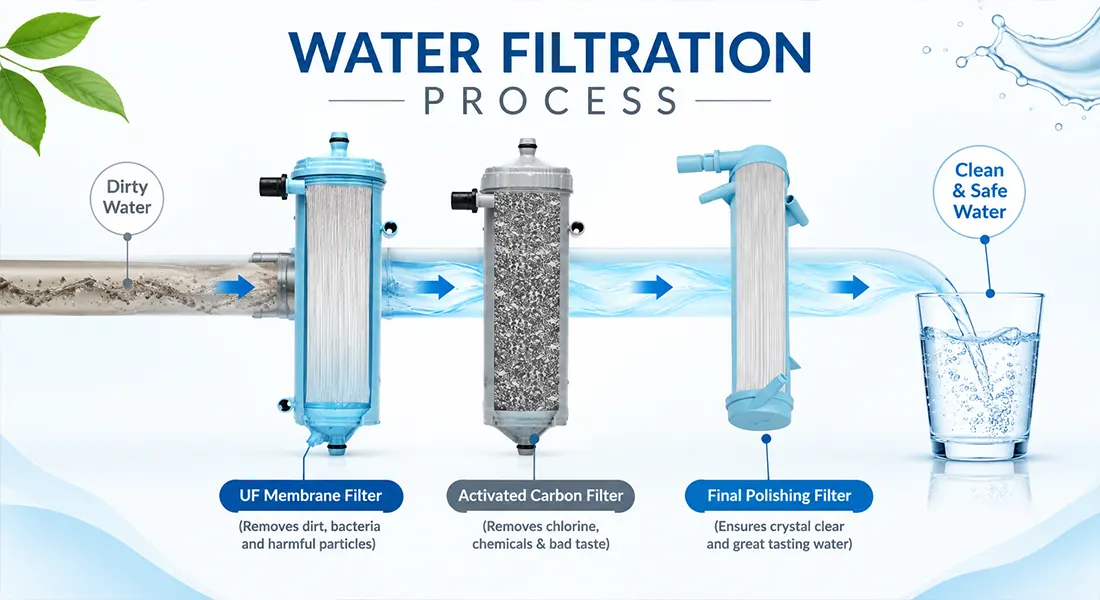
Physical Filtration
Think of physical filtration as an extremely fine sieve. Water passes through tiny openings while larger particles are blocked. Depending on the filter, this can help remove dirt, sediment and certain microorganisms.
The size of these openings determines what the filter can block, which brings us to a more advanced form of physical filtration: the hollow-fiber membrane.
Hollow-Fiber Membrane
Hollow-fiber membranes take physical filtration to a microscopic level. They contain bundles of thin, hollow fibers with tiny pores through which water passes.
LifeStraw’s membrane filters use pores approximately 0.2 microns wide, allowing water to pass through while physically blocking bacteria, parasites and microplastics.
Activated Carbon
Activated carbon works differently from a physical membrane. Its highly porous surface attracts and holds certain substances through a process called adsorption.
In selected LifeStraw products, activated carbon helps reduce substances such as chlorine and certain chemicals, while also improving the taste and odour of water.
How Does Hollow-Fiber Membrane Filtration Work?
Hollow-fiber membranes take physical filtration to a microscopic level. They contain bundles of thin, hollow fibers with tiny pores through which water passes.
LifeStraw’s membrane filters use pores approximately 0.2 microns wide, allowing water to pass through while physically blocking bacteria, parasites and microplastics.
LifeStraw ultrafilters use even smaller 0.02-micron pores, designed to block viruses as well.
LifeStraw states that its membrane microfilters can remove 99.999999% of bacteria, 99.999% of parasites and 99.999% of microplastics under specified testing conditions.
How Does Activated Carbon Work?
Activated carbon works differently from a physical membrane. Its highly porous surface attracts and holds certain substances through a process called adsorption.
In selected LifeStraw products, activated carbon helps reduce substances such as chlorine and certain chemicals, while also improving the taste and odour of water.
Why Do Water Filters Use More Than One Technology?
Water contains different types of unwanted substances, so no single filtration method can address them all.
That’s why some filters combine technologies such as membranes, activated carbon and ion exchange.
Understanding these differences helps you choose a filter based on what you want it to address and where you plan to use it.
How to Choose the Right Water Filter for Your Needs
LifeStraw offers different products using different filtration technologies, so the most suitable option depends on your specific filtration needs and how you intend to use the product.
Here is a quick guide to help you understand the differences:
| LifeStraw Product | Filtration Technology | Suitable For |
|---|---|---|
| LifeStraw Max | Membrane + carbon filtration | Higher-volume filtration for homes and offices |
| LifeStraw Community | Physical filtration | Larger groups and community settings |
| LifeStraw Flex with Gravity Bag | Membrane filtration with gravity-fed system | Portable and flexible filtration needs |
| LifeStraw Family | Hollow-fiber membrane | Household water filtration |
What Should You Consider Before Choosing?
Before choosing a product, consider the type of contaminants you are concerned about, the amount of water you need to filter, and where the system will be used.
Consider what contaminants you are concerned about.
Consider how much water you need to filter.
Consider whether the system is for personal, household, office or community use.
Once you understand these requirements, you can explore the LifeStraw options and select the product whose filtration technology and capacity best match your needs.
Explore LifeStraw Water Filtration Solutions
Explore LifeStraw filtration products available through Ara International and find a solution suited to your filtration needs.
Explore LifeStraw →Understanding Filtration Makes Choosing Easier
Water filtration may look simple from the outside, but different technologies work in different ways. Physical filtration, hollow-fiber membranes and activated carbon can each play a different role depending on the filter design and the water-quality concern.
Understanding how these technologies work can help you make a more informed choice when selecting a water filter for your home, office, travel or community.